Published October 15, 2026 · Updated October 30, 2026 · Checked by the editor against the listed sources
Before you start: This guide is general information, not medical advice. Check with your doctor or physiotherapist first if you have osteoporosis, recent surgery, a heart condition, dizziness, or pain. If you have a heart condition, uncontrolled blood pressure, balance problems, or recent joint surgery, ask your doctor which activities suit you before starting. Stop and get help immediately if you feel sharp pain, chest pain, or faint.
Cardio, or aerobic exercise, increases your breathing and heart rate to strengthen your heart and lungs. You do not need running or jumping to get a good aerobic workout—gentle, low-impact movements can protect your joints while building stamina.
This guide covers five safe, low-impact options you can do at home, both standing and completely seated. For broader training context, see our guide on cardio vs strength training for seniors.
What the Guidance Says About Cardio
Public health guidelines from the CDC recommend that adults aged 65 and over aim for at least 150 minutes of moderate-intensity aerobic activity each week.
Moderate intensity means you are breathing faster and deeper, but you can still speak in full sentences (use the talk test). You do not have to complete your activity all at once; short 10-minute sessions throughout the day add up toward your weekly goal.
What You Need and Setup
-
A sturdy chair: Choose an armless dining-style chair with a firm seat and no wheels for seated moves.
-
A clear floor space: Clear a 3-to-4-foot area free of scatter rugs, cords, or clutter.
-
Supportive footwear: Wear flat, closed, supportive athletic shoes.
-
Water and phone: Keep a glass of water and your phone within easy reach.
-
Warm-up first: Spend 3 to 5 minutes doing gentle movement before starting (see our Warm-Up Exercises for Seniors).
5 Low-Impact & Seated Cardio Exercises
Move at a steady, rhythmic pace. Always stay within a comfortable range of motion and maintain continuous breathing.
1. Marching in Place
-
Target muscles: Quadriceps, hip flexors, and calves. Builds lower-body stamina and warms up your joints.
-
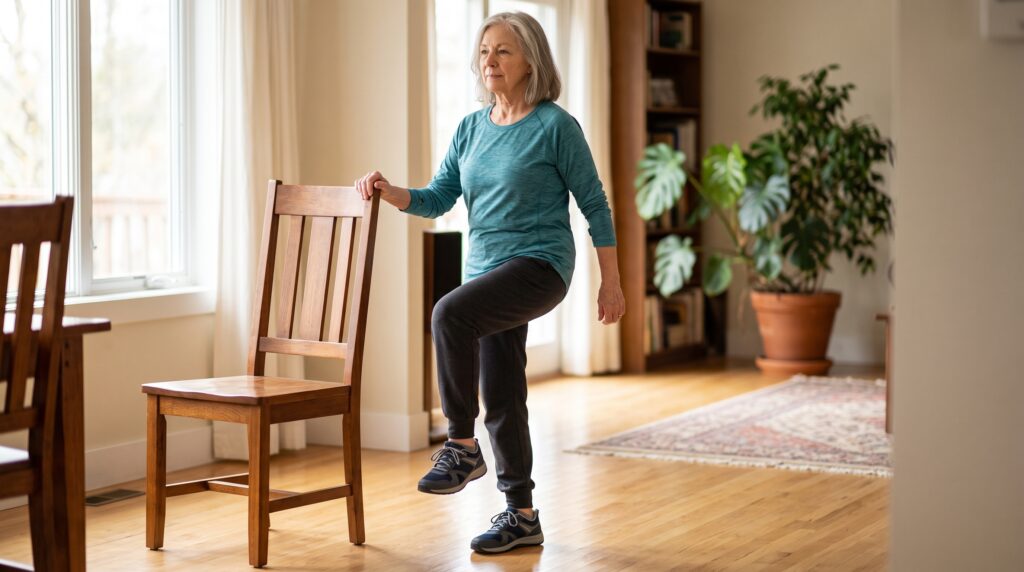
How to do it: Stand tall next to a sturdy chair or counter. Lift one knee at a time in a smooth rhythm, lifting your foot 2 to 3 inches off the floor while swinging your arms naturally.
-
Coach’s cue: “Lift your feet lightly, as if stepping on a soft carpet, while pumping your arms smoothly.”
-
Reps/Time: March continuously for 1 to 2 minutes, rest for 30 seconds, and repeat.
-
Easier version: Do the march completely seated in a chair, lifting your knees only an inch.
-
Safety check: Keep a hand resting lightly on a counter if standing balance feels unsteady.
-
How it should feel: A steady, gentle increase in heart rate and warmth in your thighs.
2. Seated March with Arm Punches
-
Target muscles: Upper body, core flexors, and leg muscles. Gives you a cardio workout with much lower balance risk.
-
How to do it: Sit forward on a sturdy chair with feet flat on the floor. March your feet in place while gently extending alternating arms forward in a controlled punching motion.
-
Coach’s cue: “Exhale as you punch forward, keeping your chest open and tall.”
-
Reps/Time: 1 to 2 minutes continuous movement.
-
Easier version: Keep your feet flat on the floor and perform only the gentle arm punches.
-
Safety check: Avoid snapping or locking your elbow joint straight on punches.
-
How it should feel: Good upper-body effort and breathing elevation without straining your joints.
3. Step-Touch Side Dance
-
Target muscles: Gluteus medius (outer hips), calves, and thigh muscles. Supports side-to-side coordination.
-
How to do it: Stand beside a counter or wall so you can reach it with one hand. Step your right foot out to the side, bring your left foot to meet it, then step left and bring your right foot to meet it.
-
Coach’s cue: “Keep your steps small and light, landing softly on the balls of your feet.”
-
Reps/Time: 1 to 2 minutes continuous movement.
-
Easier version: Perform seated side-taps, tapping one toe out to the side and returning to center.
-
Safety check: Ensure the floor is completely dry and flat before stepping side to side.
-
How it should feel: A comfortable side-to-side rhythm and steady warmth in your hips.
4. Stationary Cycling
-
Target muscles: Quadriceps, hamstrings, and calves. Supports knee flexibility with body weight fully supported.
-
How to do it: Sit on an upright or recumbent stationary bike. Adjust the seat so your knee has a slight bend at the bottom of the pedal stroke. Pedal at a steady rhythm where you can still speak easily.
-
Coach’s cue: “Push smoothly through the middle of your foot and keep your shoulders relaxed.”
-
Reps/Time: 5 to 10 minutes at low resistance.
-
Easier version: Use a portable seated pedal exerciser placed on the floor in front of your chair.
-
Safety check: Keep pedal resistance low to avoid pushing through knee joint strain. If balance is a concern, use a recumbent or step-through bike, and get on and off slowly with the bike held steady.
-
How it should feel: Smooth, continuous leg effort without joint grinding.
5. Indoor Corridor Walking
-
Target muscles: Whole lower body and core postural muscles.
-
How to do it: Walk back and forth along a long hallway or clear room. Maintain a steady, purposeful pace where you are breathing deeper but can still talk comfortably.
-
Coach’s cue: “Walk with a tall posture, swinging your arms gently from your shoulders.”
-
Reps/Time: 3 to 5 minutes of continuous walking.
-
Easier version: Walk at a relaxed pace, or keep one hand near a hallway handrail or wall.
-
Safety check: Ensure the corridor is well-lit and free of pets or floor clutter.
-
How it should feel: Natural, rhythmic breathing and steady exertion.
Coach’s Tips
Here is how I guide clients in sessions to monitor cardio intensity safely:
Essential Form Cues
-
Maintain upright posture: Avoid slouching forward in your chair or while walking. An open chest can help you breathe comfortably.
-
Keep your breathing continuous: Never hold your breath during cardio movements. Exhale during exertion and inhale smoothly.
-
Pace yourself: Start slower than you think you need to. Building stamina is usually built through steady, sustained movement.
Common Mistakes and Fixes
-
Mistake: Holding your breath during seated punching or marching.
-
Fix: Exhale audibly out loud every time you punch forward to help you keep breathing steadily.
-
-
Mistake: Stomping feet heavily on the floor while marching.
-
Fix: Land softly on the balls of your feet to reduce impact.
-
-
Mistake: Pushing into gasping breathlessness.
-
Fix: Slow down immediately. Use the talk test: if you cannot speak a full sentence, reduce your speed.
-
How I Teach It: In my sessions, I remind clients that cardio is not about gasping for air or sweating profusely. It is about keeping your body moving rhythmically so your heart gets a gentle workout.
A Simple Weekly Starter Plan
Use this simple plan to combine low-impact cardio with recovery across your week:
| Day | Target Time | Activity |
| Monday | 10 minutes | 3 min warm-up + 5 min Seated March/Punches + 2 min cool-down |
| Tuesday | Rest or Balance | Focus on gentle balance practice or light walking |
| Wednesday | 12 minutes | 3 min warm-up + 7 min Indoor Corridor Walking + 2 min cool-down |
| Thursday | Rest or Strength | Try our sit-to-stand exercise guide |
| Friday | 10 minutes | 3 min warm-up + 5 min Step-Touch Dance + 2 min cool-down |
| Weekend | Gentle Activity | Light household walking or gardening |
This plan is a starting point, about 20 minutes of cardio in the week. Build up gradually towards 150 minutes as it feels comfortable.
Quick Answers
Can I get an effective cardio workout while sitting down? Yes. Seated marching with arm punches can raise your heart rate and breathing if you keep a steady pace, with much lower balance risk and little joint impact. Use the talk test to check the effort.
How do I know if I am working at the right intensity? Use the talk test (this may not apply if you take beta-blockers). You should be breathing deeper and feeling warmer, but still able to speak in full sentences without stopping for air.
Is walking indoors sufficient for my weekly cardio goal? Yes, it can count, as long as the pace gets you breathing a little deeper (moderate effort). Same for marching while watching TV.
Warning Signs: When to Stop
Stop exercising and seek emergency medical attention immediately if you notice:
-
Chest pain, tightness, or pressure.
-
Pain spreading to your jaw, neck, back, or left arm. Call your local emergency number.
-
Sudden, severe shortness of breath or feeling unable to catch your breath.
-
Dizziness, lightheadedness, or feeling faint.
-
Sudden irregular or racing heartbeat.
Book a visit with your doctor if you experience:
-
Joint or muscle pain that worsens during exercise.
-
Shortness of breath during light daily tasks that used to feel easy.
Written by Bhavna Goheeram, ISSA Elite Trainer (2023).
Sources
Medical disclaimer: This article is for general information and education only. It is not medical advice and does not replace advice from your doctor or physiotherapist. Stop any exercise and seek medical help if you feel chest pain, dizziness, sharp pain or unusual shortness of breath.

Bhavna Goheeram — Personal Trainer and PE Teacher in Training
ISSA Elite Trainer (2023) | WABBA Level 1 Personal Trainer (2022) | SAGF Gymnastics Leader (2017)
Bhavna Goheeram is a personal trainer who holds an ISSA Elite Trainer certification and is studying to become a PE teacher. She writes and reviews the Fitness Marble guides, checking each exercise for safe, practical technique and each claim against public CDC, WHO and NHS guidance.