Published October 26, 2026 · Updated October 30, 2026 · Checked by the editor against the listed sources
Before you start: This guide is general information, not medical advice. Check with your doctor or physiotherapist first if you have osteoporosis, recent surgery, a heart condition, dizziness, or pain. If you have a heart or lung condition, take medication affecting your heart rate, or experience dizziness, ask your doctor which activities suit you before starting. Stop and get help immediately if you feel sharp pain, chest pain, or faint.
Not everyone can walk or stand for 30 minutes at a time. Arthritis, balance concerns, recovery from illness, or using a wheelchair can make standing exercise challenging.
That does not mean aerobic physical activity is out of reach. This guide offers a 12-minute cardio routine that you can perform entirely from a sturdy chair to support your heart, lungs, and overall stamina.
If you want a mix of standing and seated moves rather than a full seated routine, see our guide on Seated Cardio Exercises for Seniors: 5 Low-Impact Options. While that guide covers 5 individual low-impact options (both standing and seated), this post provides a structured, 12-minute routine performed entirely from a chair. If you are ready to build a walking habit, try our Beginner Walking Plan for Seniors: A 4-Week Guide.
Does Seated Cardio Count?
Public health guidance from the CDC for adults with disabilities and chronic conditions recommends aiming for the same physical activity goals as other adults where possible: at least 150 minutes of moderate-intensity aerobic activity each week.
However, public health guidelines also emphasize that any amount of physical activity is better than none. If 150 minutes feels out of reach right now, starting with a short seated session and building up gradually may bring health benefits.
How Hard Should Seated Cardio Feel?
To check your effort, use two simple checks recommended by the CDC:
-
The talk test: During moderate effort, you can speak in complete sentences while moving, but you breathe deeply enough that you cannot sing. For a full breakdown, see our guide on Talk Test for Exercise Intensity: Guide for Seniors.
-
The 0-to-10 Effort Scale: On a scale where 0 is resting in a chair and 10 is maximum exertion, moderate effort sits around a 5 or 6. You should feel warmer and breathe deeper, but never feel distressed or breathless.
What You Need and Setup
-
A sturdy chair: Use an armless dining chair with a firm seat and no wheels. If you use a wheelchair, keep your feet on the footplates and ensure the brakes are firmly locked.
-
Proper seating position: Sit upright with your feet resting flat on the floor or footplates.
-
Supportive footwear: Wear flat, closed shoes if using a standard chair.
-
Safety gear: Keep a glass of water and your phone within easy reach.
The 12-Minute Seated Cardio Routine
Perform each of the 6 exercises for 1 minute at an easy pace to warm up, then repeat the sequence a second time at a moderate effort level (12 minutes total). Rest for 30 to 60 seconds between rounds if needed.
Note for wheelchair users: If you use a wheelchair, replace the leg moves (March, Heel-Toe Taps, Jacks) with the arm moves (Overhead Reaches, Rowing, Punches) and keep your feet on the footplates.
1. Seated March
-
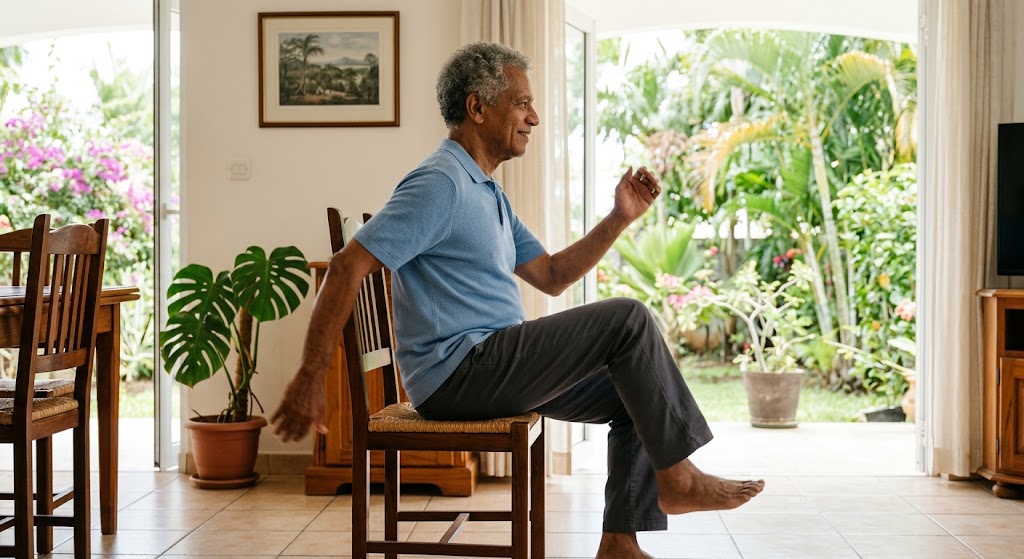
Target muscles: Quadriceps, hip flexors, and calves. Increases circulation in your legs and elevates heart rate safely.
-
How to do it: Sit tall near the front of your chair. Smoothly alternate lifting your knees upward while swinging your arms naturally at your sides.
-
Coach’s cue: “Lift your feet lightly while keeping your chest open and tall.”
-
Reps/Time: 1 minute continuous movement.
-
Easier version: Lift your knees only an inch, or tap your toes in place.
-
Safety check: Keep your torso upright; avoid slumping backward into the chair rest.
-
How it should feel: Mild warmth in your thighs and a steady rise in breathing rate.
2. Overhead Arm Reaches
-
Target muscles: Upper back, shoulders, and core muscles. Promotes chest expansion for comfortable breathing.
-
How to do it: Sit tall with feet flat. Reach your right arm gently upward toward the ceiling, bring it down, and reach up with your left arm, as if climbing a rope.
-
Coach’s cue: “Reach smoothly upward without shrugging your shoulders into your ears.”
-
Reps/Time: 1 minute continuous movement.
-
Easier version: Reach forward at chest height or at a 45-degree angle instead of straight overhead.
-
Safety check: Skip overhead reaching or keep movements below shoulder height if you have shoulder pain or rotator cuff issues.
-
How it should feel: A pleasant lengthening through your ribs and upper back.
3. Heel-Toe Taps
-
Target muscles: Calves, shins, and ankle joints. Encourages lower leg blood flow.
-
How to do it: Sit upright. Tap your right heel forward on the floor, bring it back to center, then tap your left heel forward. Alternate feet in a steady rhythm.
-
Coach’s cue: “Maintain a steady rhythm, landing lightly on your heels.”
-
Reps/Time: 1 minute continuous movement.
-
Easier version: Reduce how far forward you tap your foot so it stays closer to the chair.
-
How it should feel: Light, rhythmic work in your shins and calves.
4. Seated Jacks
-
Target muscles: Outer hips (gluteus medius), shoulders, and thighs. Supports full-body coordination.
-
How to do it: Sit tall. Step both feet outward to the sides while sweeping both arms out to shoulder height, then bring your arms and legs back to center smoothly.
-
Coach’s cue: “Move your arms and legs smoothly together, keeping your steps light.”
-
Reps/Time: 1 minute continuous movement.
-
Easier version: Perform a “half jack” by stepping one leg out at a time, or keep your arms below chest height.
-
Safety check: If you have had a recent hip replacement, ask your surgeon before stepping your legs wide apart. If using a wheelchair, keep your feet on the footplates and perform arm sweeps only.
-
How it should feel: Good coordination effort and a noticeable rise in heart rate.
5. Seated Rowing Arms
-
Target muscles: Rhomboids and middle trapezius (upper back). Counteracts forward slumping and supports posture.
-
How to do it: Reach both arms straight forward at chest height. Pull your elbows straight back along your sides, squeezing your shoulder blades together, then reach forward again.
-
Coach’s cue: “Drive your elbows backward and imagine squeezing a walnut between your shoulder blades.”
-
Reps/Time: 1 minute continuous movement.
-
Easier version: Perform smaller rowing pulls with your elbows kept lower.
-
How it should feel: A firm, comfortable working squeeze across your mid-back.
6. Seated Boxing Punches
-
Target muscles: Shoulders, chest, and torso rotators.
-
How to do it: Sit tall with hands near chest height. Gently extend your right arm forward in a controlled punch, return to center, and punch forward with your left arm.
-
Coach’s cue: “Exhale as you punch forward, keeping your shoulders relaxed and down.”
-
Reps/Time: 1 minute continuous movement.
-
Easier version: Punch gently at a slower tempo without rotating your torso.
-
Safety check: Avoid snapping or locking your elbow joint straight on punches. If you have osteoporosis, keep your torso still and punch straight ahead.
-
How it should feel: Satisfying upper-body effort and steady aerobic rhythm.
Coach’s Tips
Here is how I guide clients in sessions to get the most out of seated exercise:
Essential Form Cues
-
Maintain a tall spine: Imagine a string lifting the crown of your head gently toward the ceiling. Slouching can make breathing feel harder.
-
Never hold your breath: Exhale during exertion (like punching or reaching); inhale smoothly on the return.
-
Pace your effort: Start Round 1 gently as a warm-up. Only increase your speed in Round 2 if your joints feel comfortable and your breath is steady.
Common Mistakes and Fixes
-
Mistake: Slouching into the back of the chair while marching or punching.
-
Fix: Sit slightly forward on your seat so your core muscles work to keep your spine upright.
-
-
Mistake: Holding your breath during fast movements.
-
Fix: Count your repetitions out loud or breathe out audibly on every punch to keep air moving smoothly.
-
-
Mistake: Moving too fast and getting breathless in the first 2 minutes.
-
Fix: Slow your tempo down. Seated cardio works best when maintained as a steady, continuous rhythm.
-
How I Teach It: In my sessions, I remind clients that seated cardio is just as valid as standing work. Keeping your arms and legs moving rhythmically from a chair gives your heart and lungs a workout with much lower balance risk.
A Simple Weekly Plan
Use this gradual progression to build your seated cardio habit:
| Weeks | Frequency | Session Length | Focus |
| Weeks 1 to 2 | 3 days a week | 6 minutes (Round 1 only) | Focus on learning the moves and posture |
| Weeks 3 to 4 | 3 to 4 days a week | 12 minutes (Rounds 1 & 2) | Build continuous aerobic stamina |
| Week 5 onward | 4 to 5 days a week | 12 to 20 minutes | Gradually increase session time as comfortable |
Note: You can split your sessions into shorter bouts, which still count toward your weekly total. The 2-minute cool-down adds a little extra time to each workout.
This plan is a starting point. Build up gradually towards 150 minutes a week of moderate activity as it feels comfortable, adding walking or other activity if you can.
Cool-Down
When you finish your second round, spend 2 minutes slowing your pace down to transition safely:
-
March your feet very slowly for 1 minute (or swing your arms gently if using a wheelchair).
-
Take 4 slow, easy breaths, inhaling as you raise your arms slightly and exhaling as you lower them.
-
Sit quietly for 1 full minute before attempting to stand up or transfer to help avoid dizziness.
Quick Answers
Is seated cardio as effective as walking? Seated activity effectively raises your heart rate and breathing, but walking engages more body weight and large leg muscles. For anyone unable to stand or walk safely for long, regular seated cardio is a valuable option for cardiovascular health.
Can I do this routine while watching television? Yes, as long as you maintain a steady, safe rhythm and do not get distracted from keeping good posture.
How will I know if the routine is working? Over a few weeks, you may notice that daily tasks—like dressing or moving around the house—leave you less winded, and completing the 12-minute routine feels smoother.
Can I add hand weights to this routine? Establish your stamina with bodyweight movement first. If you want to add resistance later, ask your doctor or physiotherapist if holding very light hand weights (1 to 2 lbs) is suitable for your joints.
Warning Signs: When to Stop
Stop exercising and seek emergency medical attention immediately if you experience:
-
Chest pain, tightness, or pressure.
-
Pain spreading to your jaw, neck, back, or left arm. Call your local emergency number.
-
Severe shortness of breath or feeling unable to catch your breath.
-
Dizziness, lightheadedness, or feeling faint.
-
Sudden weakness, face drooping, or trouble speaking. Call your local emergency number.
Book a visit with your doctor if you notice:
-
Shortness of breath during light daily tasks that used to feel easy.
-
Persistent joint pain or swelling after exercise sessions.
Written by Bhavna Goheeram, ISSA Elite Trainer (2023).
Sources
Medical disclaimer: This article is for general information and education only. It is not medical advice and does not replace advice from your doctor or physiotherapist. Stop any exercise and seek medical help if you feel chest pain, dizziness, sharp pain or unusual shortness of breath.

Bhavna Goheeram — Personal Trainer and PE Teacher in Training
ISSA Elite Trainer (2023) | WABBA Level 1 Personal Trainer (2022) | SAGF Gymnastics Leader (2017)
Bhavna Goheeram is a personal trainer who holds an ISSA Elite Trainer certification and is studying to become a PE teacher. She writes and reviews the Fitness Marble guides, checking each exercise for safe, practical technique and each claim against public CDC, WHO and NHS guidance.