
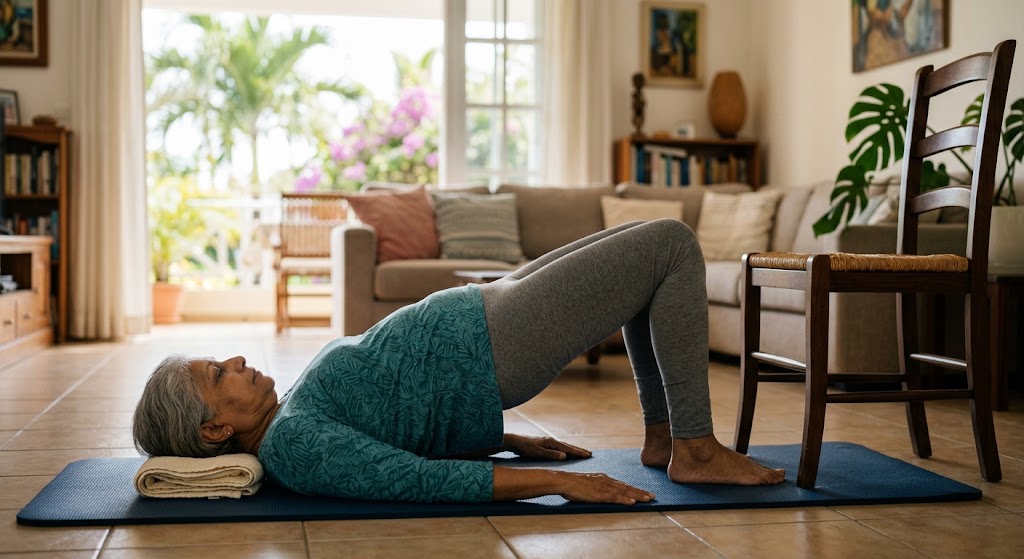
Pilates has a reputation for being flexible, bendy and hard. In reality, the core ideas are gentle and easy to scale: slow breathing, controlled movement, good alignment and a steady centre. That is why many older adults find it approachable, and why many physiotherapists use similar moves in rehabilitation.
This guide explains what Pilates involves, gives you six beginner moves you can do on a mat or a chair, and shows how to start without overdoing it.
What the evidence says (and doesn’t)
Public health guidelines recommend that older adults include balance and muscle-strengthening activity each week, and Pilates-style movement can be one way to do that. Research on Pilates specifically in older adults is encouraging, but many studies are small and of mixed quality, so it is best seen as one good option rather than a proven cure for anything. It works best alongside walking and leg strengthening such as sit-to-stands.
Who should check first
Ask your doctor or physiotherapist before starting if you have:
- Osteoporosis or a past spinal fracture (several classic Pilates moves involve deep forward bending or twisting and are usually advised against)
- A hip or knee replacement, or recent surgery
- A heart condition or blood pressure that is hard to control
- Dizziness, balance problems or a recent fall
- Significant back, neck or joint pain
What you need
- A firm, non-slip mat, or a firm bed if getting to the floor is difficult
- A sturdy chair with a firm seat and no wheels
- A small folded towel for under your head
- Comfortable clothes and flat, grippy shoes for the standing parts
The 6 beginner moves
Do 6 to 8 slow repetitions of each. Breathe out on the effort.
- Rib-cage breathing. Lie on your back, knees bent. Rest your hands on the sides of your ribs. Breathe in and feel your ribs widen. Breathe out slowly and feel them close. Do 5 breaths.
- Pelvic tilt. Gently flatten your lower back toward the mat by tightening your belly, then release.
- Knee fold. Keeping your pelvis still, lift one foot a few centimetres and lower it. Alternate feet.
- Bridge. Press through your feet and lift your hips a few inches, squeezing your buttocks, then lower slowly.
- Seated pelvic tilt. On a chair, sit tall. Gently rock your pelvis back and forward, as if rolling a ball under you.
- Seated arm reach. Sit tall and reach one arm forward, then the other, keeping your shoulders down and ribs steady.
When going through these moves with my grandparents, the hardest part for them was coordinating the breathing without tensing their neck and shoulders. A helpful cue is to imagine your collarbones are widening away from each other as you breathe out, which keeps your neck relaxed and lets your core do the actual stabilizing work.
Your first month
| Week | Frequency | Time | What to do |
|---|---|---|---|
| 1 | 2 days | 10 minutes | Moves 1 to 3, one round |
| 2 | 2 to 3 days | 12 minutes | Moves 1 to 4, one round |
| 3 | 3 days | 15 minutes | All six, one round |
| 4 | 3 days | 15 to 20 minutes | All six, two rounds |
Rest a day between sessions where you can.
Joining a class
A class can help with technique. Look for an instructor with a recognised Pilates qualification and experience with older adults, small groups, and a willingness to adapt moves. Tell them about every health condition and medication before the first session. Avoid anyone who pushes you into pain or promises results.
Common mistakes
- Holding your breath. Keep breathing steadily.
- Moving fast. Slow control is the point.
- Pushing the range. Smaller is fine.
- Gripping your neck and shoulders. Keep them relaxed.
- Copying advanced videos. Start with beginner material only.
Stop and get medical help if you notice: chest pain or pressure, dizziness or faintness, severe shortness of breath, sharp or sudden back or joint pain, numbness or tingling, or new swelling. Mild muscle tiredness is normal.
Quick answers
Do I need to be flexible? No. You don’t need to touch your toes or be flexible to begin.
Can I do Pilates after a hip replacement? Often yes, with changes. Ask your surgeon or physiotherapist about which moves are safe.
Is chair Pilates real Pilates? It uses the same principles of breathing, control and alignment, adapted for support.
How soon will I notice a difference? Some people feel steadier and more aware of their posture within a few weeks, but it varies.
Sources
Medical disclaimer: This article is for general information and education only. It is not medical advice and does not replace advice from your doctor or physiotherapist. Stop any exercise and seek medical help if you feel chest pain, dizziness, sharp pain or unusual shortness of breath.

Arthur Sterling — Founder and Editor
Not a medical professional
I started Fitness Marble because of my grandparents, to help older adults stay independent, confident and strong in their own homes. My background is in quality assurance and project management. I am not a doctor, physiotherapist or dietitian, and nothing here is medical advice.
Read more
Growing up, my grandparents instilled in me my core values and a deep sense of responsibility as the eldest son. As they grew older, their care shaped what I want this site to do.
My career has been in quality assurance and project management. That means I check details and follow a strict process, and that is how I work here. My job is to read public guidance from trusted sources such as the CDC, the World Health Organization and the National Institutes of Health, and turn it into simple, practical routines you can actually follow.
Every article lists its sources at the bottom so you can check them yourself. You can read how articles are researched and checked on our Editorial Policy page.
I write under the pen name Arthur Sterling to protect my privacy, but I remain fully accountable for what is published here. If you spot a mistake, email me at contact@fitnessmarble.com and I will correct it promptly.
Please talk to your own doctor before starting any new exercise programme, especially if you have a health condition or take medication.
